
Reviews of
Daniel Kaufman
And the earth was without form, and void; and darkness was upon the face of the deep. And the Spirit of God moved upon the face of the waters.
— Genesis 1:2
Arise in the morning like a lion, and do the bidding of your Creator.
—Shulchan Aruch 1, 1.
Full fathom five thy father lies;
Of his bones are coral made;
Those are pearls that were his eyes;
Nothing of him that doth fade,
But doth suffer a sea-change
Into something rich and strange.
—Shakespeare, The Tempest, I, ii.
Here external Reason says: God has created the soul in flesh and blood in the outer world, what harm can that do it? This Reason knows no more of the soul’s origin than a cow does of a new stable door. She looks at it, and it seems to her to be strange; so also to external Reason the inner world seems to be something strange.—Jacob Boehme, Six Theosophic Points
Painter Daniel Kaufman’s Physics as Metaphysics
by
Jamey Hecht, Ph.D, Psy.D, Poet
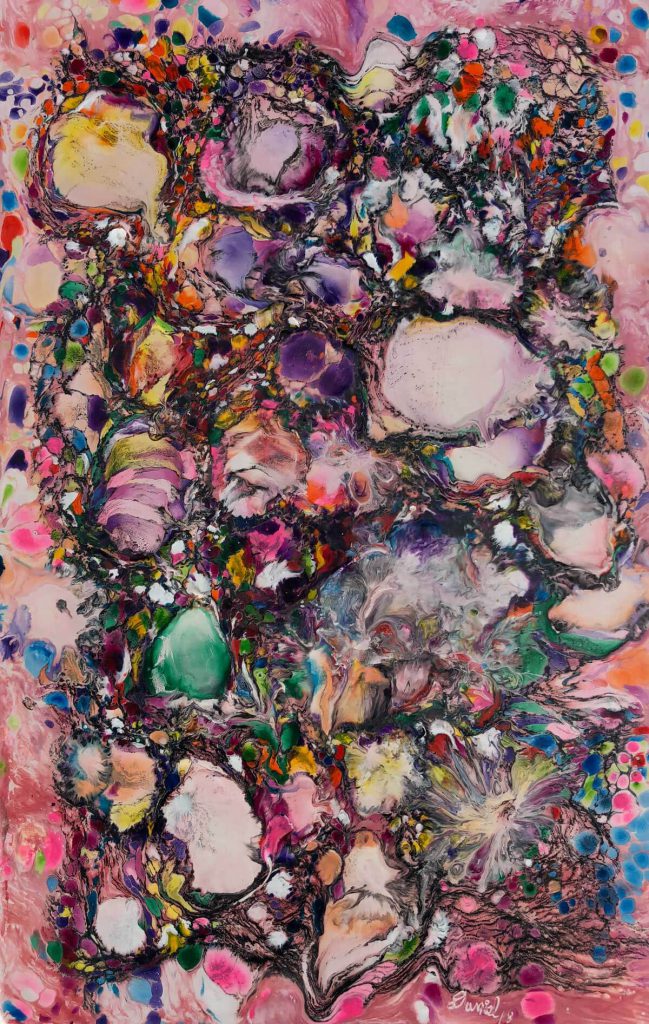
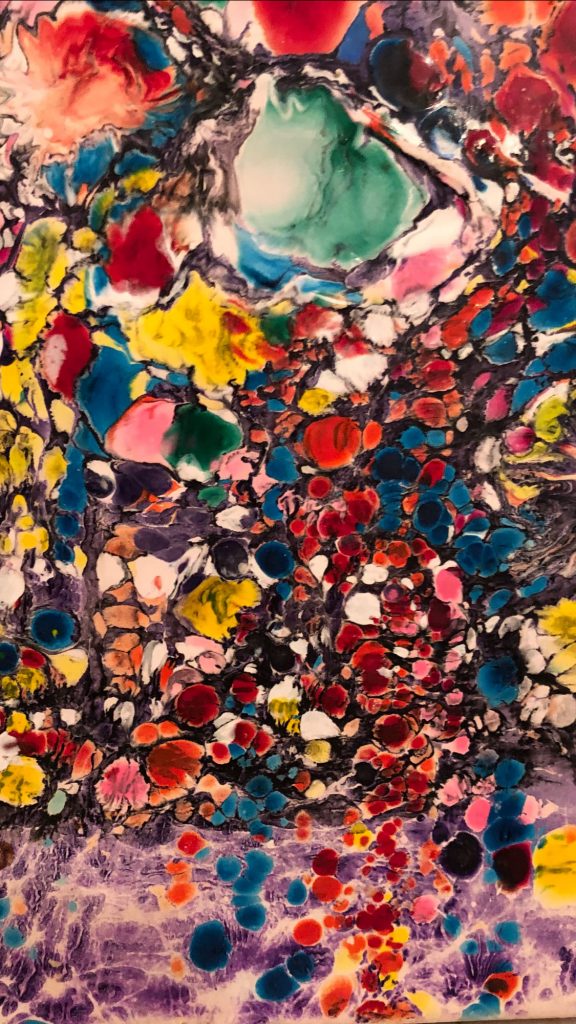
Daniel Kaufman’s paintings are “something strange.” They seem to slice their way into reality, from an unusual angle, and at a stroke. His actual artistic process is nothing like that, of course. A similar gulf separates the artist’s own personal manner, from the manner of these canvasses as one stands gazing into them. The artist is courteous, thoughtful, menschey; the pictures are sovereign, primordial, and commanding. That asymmetry is one of many hints that this body of work and its master are the real thing. Daniel Kaufman is incapable of making a bad painting. He is also getting old enough to have rounded that dark corner in every unaborted artistic career in which it becomes evident to the person holding the brush that extinction really is going to vaporize the visible portion of him, and the artmaking takes on a different existential scent. There is less worry, and more smiling; less hope, and more action; less future and past, and instead an abundant metaphysical now already hitting a few “notes” of the Divine as each sip of reflected light tells the brain’s optical tongue just what it is doing. This painter, like so many others, has said, “Every painting is an experiment; I learn each time; it’s a co-creation with a higher power; nothing is preplanned; it’s all unconscious; the paintings make themselves.” The pictures make us expect this traditional perspective on creativioty, though they are themselves innovations in method and outcome.
In pursuit of a verbal idiom that can answer to the visual idiom of Kaufman’s works, I’d like to quote at length the German mystic Jacob Boehme (1575 –1624), from Point Five of his Six Theosophic Points, written in 1620 (J.R. Earle, trans.):
God has introduced the soul into flesh and blood, that it might not so easily become susceptible of the wrath-essence. Thus it has its delight meanwhile in the mirror of the sun, and rejoices in the sidereal essence. Presented to it is (1) the light-world in its true fire, (2) the dark world in the fire-root, (3) the outer elemental world in the astral source. Among them hovers the great mystery of the soul’s fire. The world to which the soul unites and abandons itself, from that it receives substance in its imagination. But because it has in Adam turned itself to the spirit of this world, and carried its imagination into the same, its highest desire is now in the essence of the sun and stars, and by this desire it draws the spirit of the outer world with its substance of four elements continually into itself, and has its greatest joy therein; in which it is in a strange lodging as guest, for the abyss is beneath it, and there is great danger. 21. Here external Reason says: God has created the soul in flesh and blood in the outer world, what harm can that do it? This Reason knows no more of the soul’s origin than a cow does of a new stable door. She looks at it, and it seems to her to be strange ; so also to external Reason the inner world seems to be something strange.
People will be experiencing these Daniel Kaufman paintings “so long as men can breathe, or eyes can see”—Shakespeare’s phrase from Sonnet 18, for the immortality of art when it successfully confers on a beloved person the privilege of perpetual acknowledgment. These days, however, our species “hath all too short a date.” What art was born to do, is now a job beyond the powers of mortal hands. Art can’t do its job—which is to perpetuate the human image as a gift in the service of the abiding human community across time (“tradition”)—in a circumstance that suspends confidence in the future of humanity. That is, when all of us are dead, it won’t matter how great the paintings and the poems are. Until then, however, art remains while we remain, likely to learn about ourselves by noting the uses to which we put such art as our historical moment affords. Ultimately, I recommend Daniel Kaufman’s paintings for that reasons, and for the pleasure of what the image does inside the nervous system when you connect to the image. It enters the eyes and goes on from there.
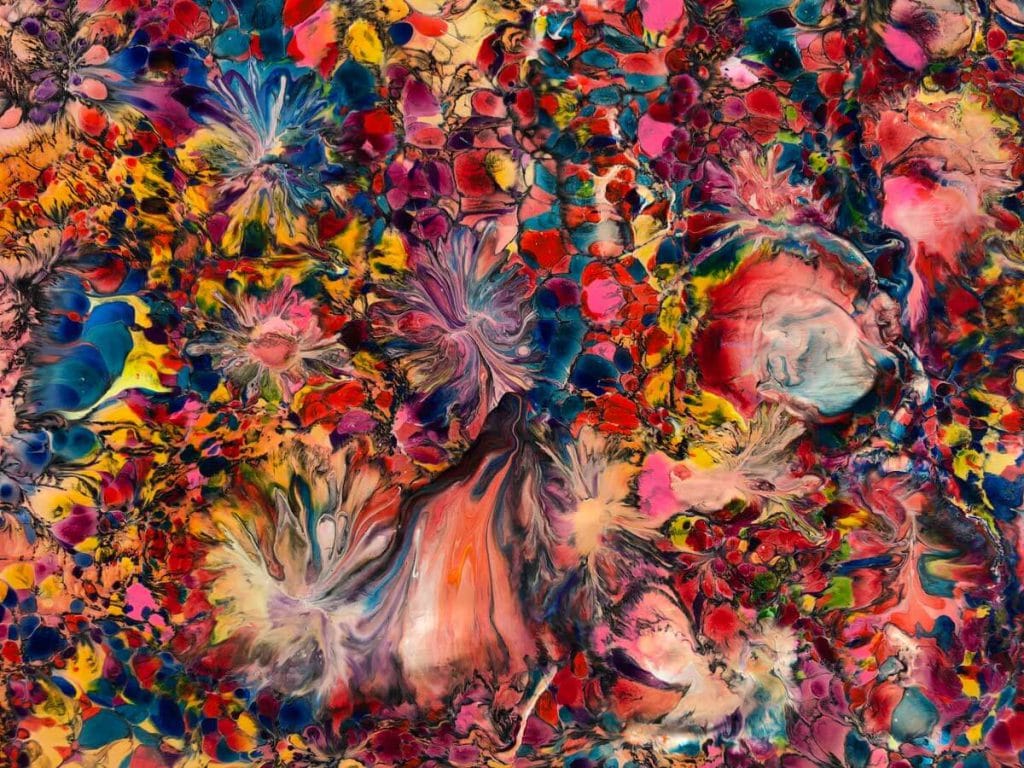
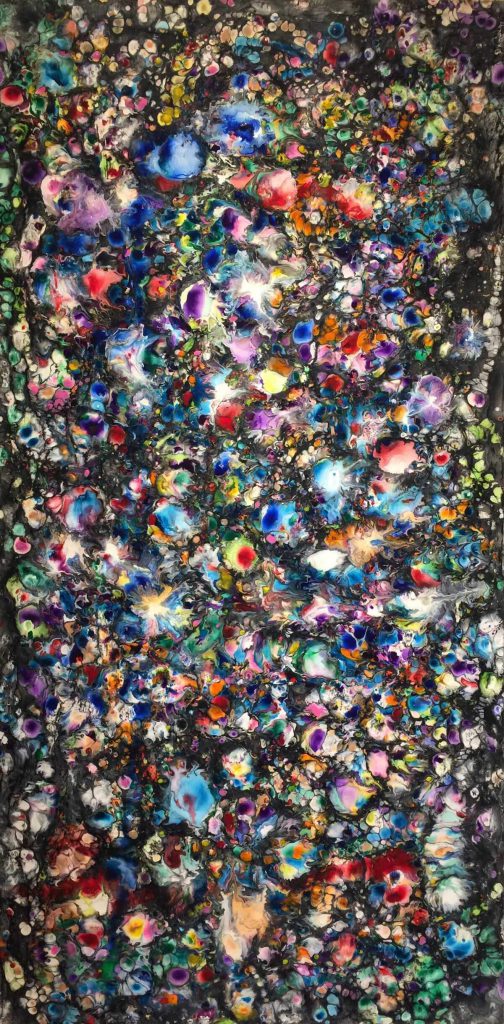
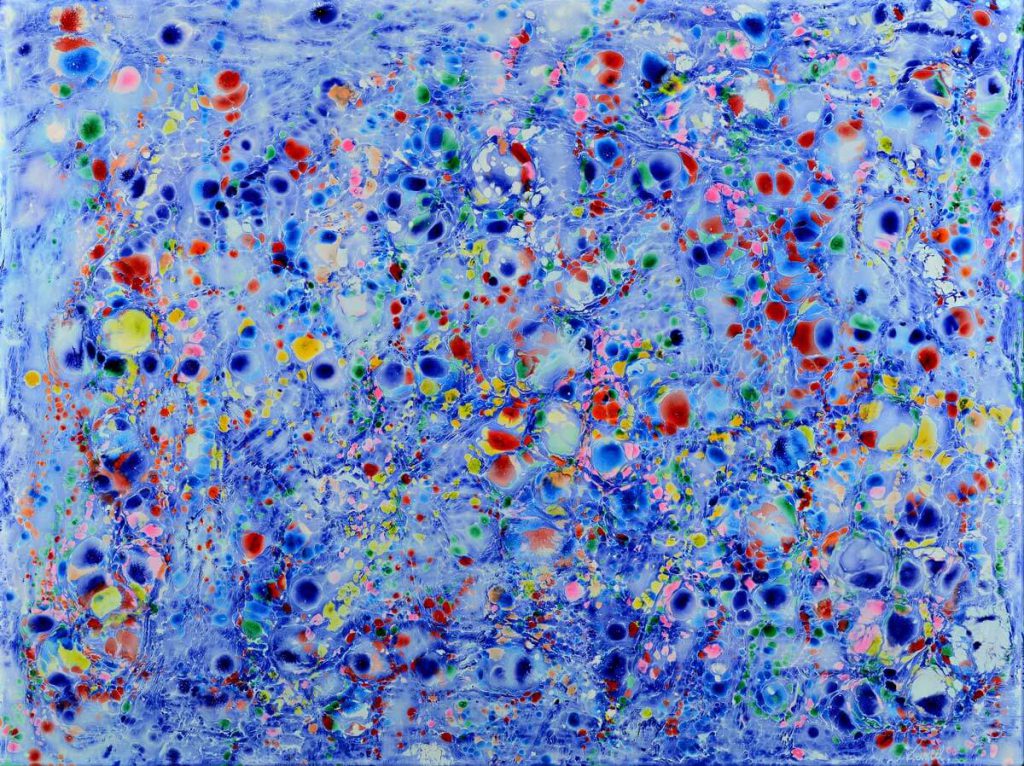
Perhaps all abstract expressionism is elemental, since the term abstraction suggests a drawing-away-from specific details that are local to particular objects, a departure from figuration and a choice to evoke more fundamental aspects of the world instead. But Kaufman’s work seems especially elemental, because is addition to its exploration of colors as part of the world, it also presents various basic spatial facts about the way life looks and behaves. Biomorphic vesicles are everywhere, some of them with nuclei like real eukaryotic cells such as we have, often connected by myriad fibers of color in the wax. There is not a single brushstroke in the technique, which involves melting crayons with a heat gun which is then wielded expressively against the resulting surface of layered, melting (or melted or remelted) crayon bits.
Biomorphic vesicles are everywhere in nature, and the fluid dynamics that govern Kaufmann’s molten waxes are the same ones that wove the first organisms in the universe, and us. This seems to be part of the paintings’ subject matter. These abstract expressionist paintings do have a subject matter, upon which some of the titles seem to insist: “Divine Mother Matrix,” “Jewelled Heaven,” “The Force,” and “At Play in the Gardens of Hashem” are among the more plainly religious. But to this writer, “Full Moon Rising” and “Jubilant” and “Telluric Abstraction” feel religious, too, as the paintings they name tend to activate a part of me that is moved by thought of origins, and of a Source, and of the roots of complexity in simplicity, the roots of time in eternity. To look at two and then three and then fifty of these paintings, is to go from feeling that Kaufmann is “onto something”, to having a stand-alone experience of communion with some deep layer of the reality disclosed by our visual equipment, our psychic attention, our unbound feelings loosed by abstraction, bounded by wax.
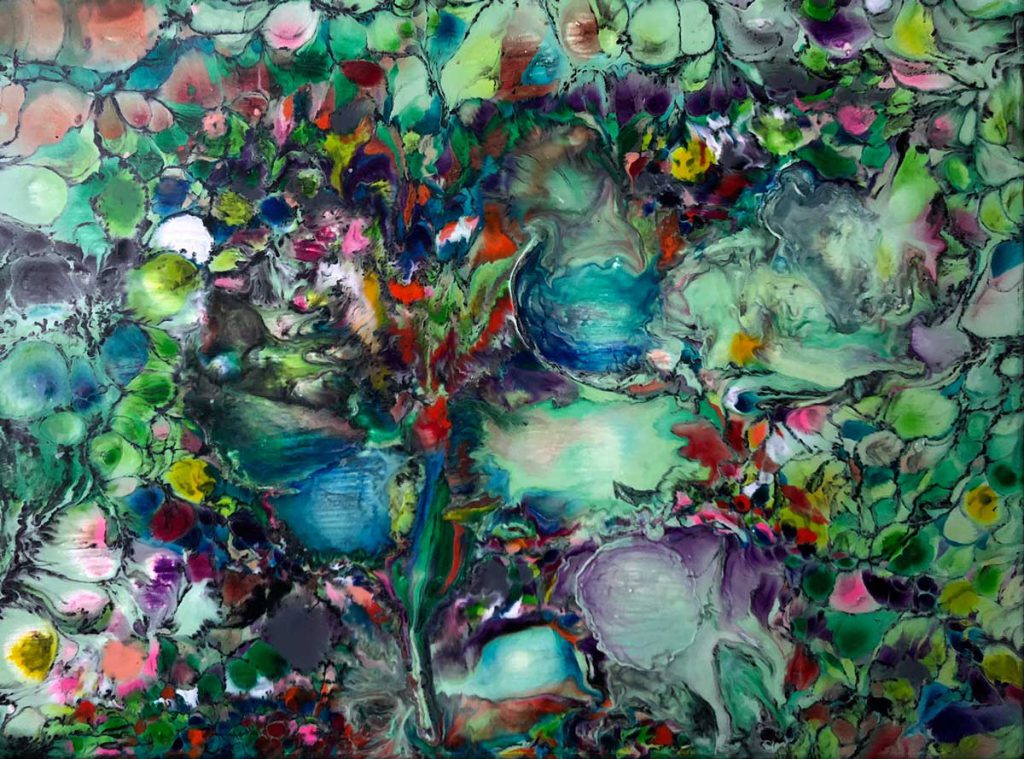
Color is amazingly alive in these paintings, in part because the pigments in the crayons seem to be bring fairly high degrees of saturation. Not all the shapes are biomorphic; some passages seem to show processes that happen in the real world at a much smaller scale than that of cells and organelles. In “Landscape with Sprites” and in “Turqoise Landscape,” for instance, I see trees only briefly, hills only for a moment, whereas both pictures become and remain stories about the churning of different gasses inside a star. I have had this impression for a long time, and it occurred to me the first time I saw Kaufman’s work: these are about the formation of the elements, inside of the stars. The colors are like the particles and atoms in the solar interior; the heat-gun in the painter’s grip is the fusion process that drives the colors into proximity. The colors do not seem to mix. They draw one another up to borders, or they intermingle in ways that look fibrous, filamented, radial. Nothing is centered, there are no straight lines or regular polygons, no fierce circles out of Plato. “Time is the school in which we learn, / Time is the fire in which we burn,” wrote the American Jewish poet Delmore Schwartz. In Kaufman, color is the fire in which we learn, whereas time has stopped since the wax cooled. Time has done no such thing, of course, but watching these paintings (in the verbal sense of “watching a movie”) is like sipping at a static “now”, tangent to eternity, while the glimpses of underlying order seem to shimmer from, as it were, a vast depth of something which is nevertheless spaceless: feelings. These paintings are, in the best sense, panpsychist imagery that evokes the affective dimension of some fundamental physical processes and structures, not least of which is the fluid dynamics governing the medium itself, liquid wax, manipulated in an eight-step process using a heat-gun. Beside these fluid dynamics, a viewer might find in these pictures the formation of atoms inside a star; of stars in protogalactic clouds; or the teeming competitive and cooperative world of unicellular life; or of corals and sea foliage. The paintings are innocent of any binding criterion that would fix their scale, like the dime that auctioneers sometimes place in a photograph of a vase to establish its relative size. Plato’s Ion describes a chain of inspiration from the Divine to a poet, namely Homer, to a professional reciter (rhapsode) of Homer’s poems, namely Ion, to an audience. Kaufman seems to be as much in the hand of a living God as the heat-gun is in his own, human hand. So, go see these paintings.